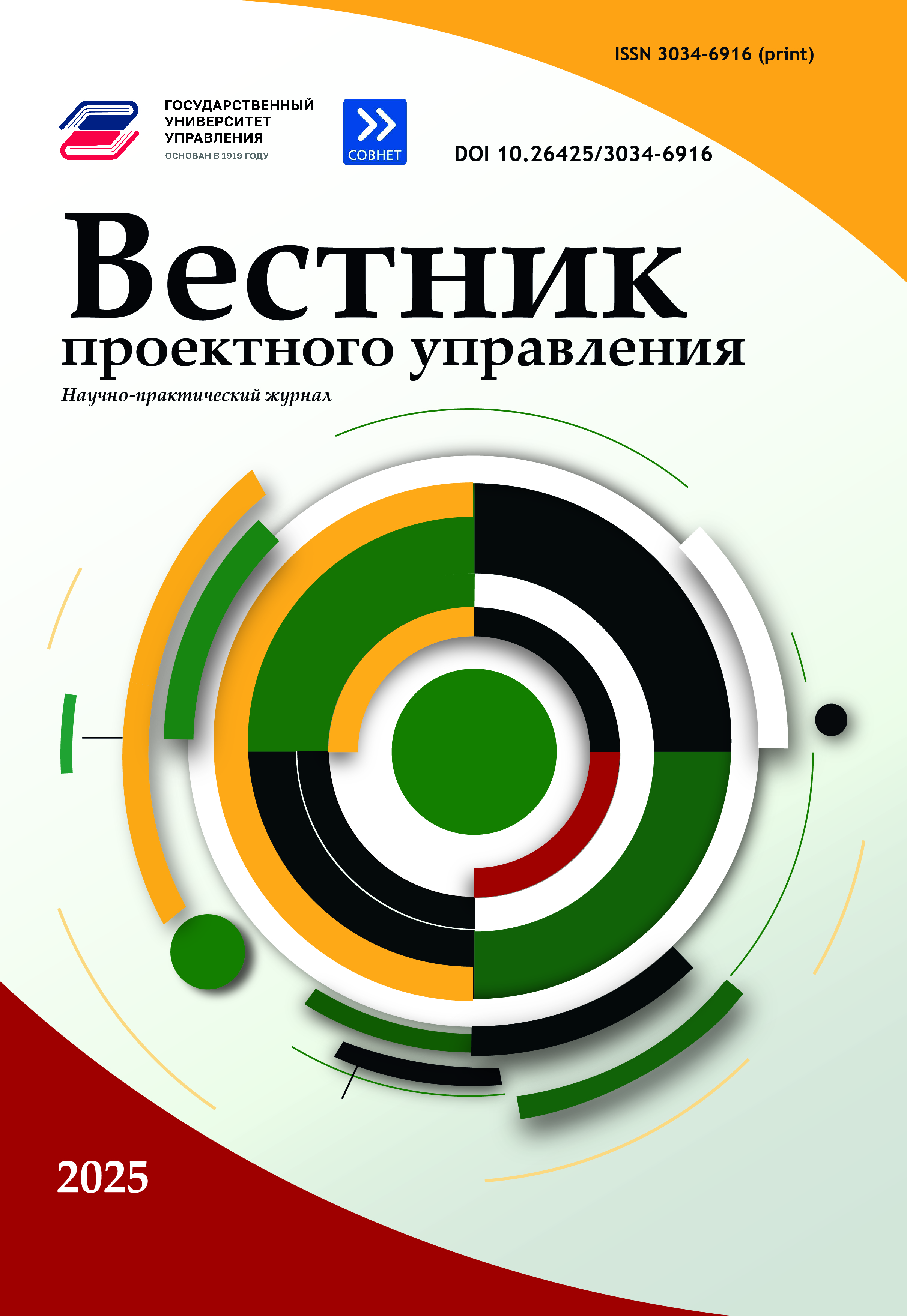
Journal Overview
Journal of Project Management is dedicated to current issues in project management, including its methodology, tools, and practices. Its primary goal is to disseminate advanced knowledge, practical recommendations, and scientific research in the field of project management. The publication is intended for researchers, practitioners, students, and anyone involved in project activities across various industries.
Journal Mission
The Journal of Project Management aims to become a leading platform for knowledge and experience exchange in project management, fostering the development of theories and practices related to project, program, and portfolio management. Our mission is to unite scientific research, innovative ideas, and practical case studies to enhance project efficiency and create value for organizations across different sectors of the economy.
Journal Focus:
- Coverage of modern approaches and methods in project management.
- Research on change and risk management.
- Best practices and case studies of successful project implementation.
- Current tools and technologies applied in project management.
Target Audience:
- Project managers, project leaders, and specialists in program and portfolio management.
- Top executives making decisions on implementing project management.
- Consulting firms offering project management implementation services.
- Educational institutions (universities, business schools) teaching project management.
- Students and participants of specialized programs.
Current issue
EXPERIENCE AND PRACTICE
The key aspects of project management maturity models, their classification, assessment methods, and practical significance for business are studied. The approaches of international and national standards to the project activities concept have been analyzed, and the process of project management system diagnostics has been described, including the stages of model selection, data collection, and plan development.
Special attention has been paid to the application of maturity models for assess ing the current state, planning transformation, investment justification, certification, and benchmarking. It has been emphasized that the systematic use of these frameworks makes it possible to synchronize projects with strategy, increase the predictability of results and build a culture of continuous improvement.
Scenarios for identifying “bottlenecks”, forming roadmaps, and evaluating the effectiveness of changes have been considered. The role of diagnostics as a tool for reducing project risks has been noted. It has been shown how frameworks adaptation to industry specifics ensures the realism of the targets. The top-level steps for the project management system implementation have been outlined. The recommendations are addressed to both companies at the initial stage and mature companies.
The study will be useful for managers responsible for project activities development, project offices representatives, and specialized services.
The evolution of information system integration projects has been analyzed, and the impact of AI technologies on its current and future tasks has been assessed. It has been shown that system integration has gone from point solutions and data transmission protocols unification to forming an integration layer of corporate IT architectures, which is a key element of the digital transformation of high-tech sectors of economy. With the high maturity of data exchange technologies, the economic efficiency of integration projects is still limited by the complexity of architectural solutions and a high proportion of manual labor.
The author has proven how modern AI tools transform the practice of system integration, shifting the focus from manual implementation of integration mechanisms to intelligent quality management, sustainability, and risks of functioning of integration ecosystems. The key areas of AI application in relevant projects (design automation and integration solutions documentation, software artifacts generation, intelligent monitoring of data flows, predictive failure management, and autonomous orchestration of continuous integration processes and software delivery) have been analyzed.
It has been concluded that AI tools by 2026 can significantly reduce the complexity and time of integration projects, while maintaining the leading role of human in making architectural and strategic decisions.
The cultural context of project management in Uzbekistan, one of the fastest growing markets in Central Asia, attracting a significant amount of Russian investment, has been analyzed. Historical proximity and shared post-Soviet experience often create the illusion of cultural predictability, which in practice results in managerial failures.
Based on more than 15 semi-structured interviews with investors, government officials, project managers, and independent experts on Central Asia, 7 key cultural characteristics that determine the success or failure of projects in the business environment in Uzbekistan have been identified: hierarchical vertical, inshallah management, hop communication, social relations system (mahalla), the local intermediary (explorer) institution, a short-term planning horizon, and a dual calendar.
The research has been carried out in an intelligence design: its purpose is not to generalize statistics, but to form a primary conceptual map of the cultural context as a basis for subsequent quantitative research. Specific management solutions have been proposed for each of the identified features, allowing standard project tools to be adapted to the local environment without abandoning them. The study will be useful for Russian companies implementing or planning projects in Uzbekistan and Central Asia in general.
The procedure for forming a portfolio of company’s strategic initiatives (projects aimed solely at achieving its system of strategic goals), initiated from the system of company’s strategic goals, has been studied. In this portfolio, strategic initiatives are selected and formed solely to achieve strategic goals, rather than by rating them and then balancing them with a further definition of the purpose of each project.
The projects of strategic project portfolio set the task of achieving one or another strategic goal of company’s strategic goals system. After its formation, no prio ritization or balancing should take place. The rationale for this approach has been given, following from company’s developed strategy. This approach contradicts the approaches approved in international and Russian project portfolio management standards and is aimed solely at implementing company’s strategy, rather than formally filling a portfolio of strategic initiatives with projects already available in company by ranking and balancing them. A portfolio of strategic initiatives should be managed within the framework of company’s strategic management system. It has been emphasized that the formation of other (non-strategic) project portfolios should be carried out in accordance with international and Russian project portfolio management standards.
The proposed approach requires discussion by project management specialists and adjustments to Russian project portfolio management standards.
THEORY AND METHODOLOGY
Modern medium and large businesses in Russia require a practice-oriented approach to the implementation of projects that should lead to a qualitative change in company’s business processes. This is also relevant for preparing companies for the transition to management based on the principles of sustainable development.
A practice-oriented approach to implementing change projects in Russian companies through consulting projects adapted to the specifics of the local business context has been presented. A universal eight-step algorithm has been proposed, which includes such steps as diagnosing the current state of business processes, forming change arrangements, developing a methodology for changes, training employees, implementing changes using software, scaling to a selected target group, and post-project implementation support. Using the example of corporate time management implementation, the authors demonstrate how operational improvements (overdue orders reduction, meetings optimization, and transparent loading) create the foundation for further strategic transformation towards sustainable development. Special attention has been paid to the role of consultants as facilitators, joint decision-making with employees, and the integration of digital tools to bring about change.
The research paper will be useful for managers, consultants, and researchers involved in organizational transformation and implementation of changes in Russian companies.
In the current highly competitive environment, effective project management is becoming an essential factor for sustainability. The authors present a compar ison of widely used models for assessing the maturity of project management: the Kerzner Project Management Maturity Model (PMMM) and the Organizational Project Management Maturity Model (OPM3) developed by the Project Management Institute. The theoretical foundations of the maturity concept, the evolution of models, their structural elements, evaluation methods, as well as the role of each model in ensuring the connection of project activities with company’s strategic goals have been analyzed.
The comparative analysis has been performed on a wide range of criteria, including the relationship with corporate strategy, assessment methodology and resource requirements, impact on organizational culture, and other aspects rel evant to the choice of a model in practice. Based on the results obtained, rec ommendations have been formulated: the PMMM is optimal for small companies or companies at the initial stages of project management development, while OPM3 is an effective tool for large holdings seeking to integrate project activities with strategic goals.
The study results can be used by companies to select the most appropriate model.
The purpose of the study is to systematize domestic and foreign studies on the role of tacit and product knowledge in project management and to build an analytical model explaining the impact of this knowledge on the success of projects and the creation of product value. The methodological basis is a problem-chronological review of the scientific literature, including classical works on tacit knowledge, knowledge management studies, publications on project and product management, as well as Russian-language sources presented in the open press. It has been shown that tacit knowledge provides context interpretation, coordination of actions, and transfer of experience, whereas product knowledge connects project decisions with user needs, business goals, and expected effects. It is difficult to form tacit knowledge among students using traditional technologies of the educational process at universities, since the latter are primarily based on verbal forms of information.
Business, especially in the context of total digitalization and artificial intelligence implementation, needs specialists who are able to work with non-verbal information that forms the basis of product knowledge. The novelty of the research consists in considering tacit and product knowledge as complementary resources of project activity and in highlighting the contours of their identification, joint meaning formation, application, preservation, and transfer to corporate competencies.
The practical significance of the research lies in the possibility of using the proposed model in the development of project offices, product teams, knowledge management systems, and corporate knowledge bases.
SCIENTIFIC RESEARCH AND REVIEW
The transition of the Algerian oil and gas sector from the model of increasing production that has been established for many years to the model of sustainable project management has been studied. Based on the analysis of foreign and domestic scientific sources, it has been shown that the modern scientific discussion has shifted from understanding sustainability as a scientific definition to operationalizing ESG criteria at the level of specific projects. It has been proved that, in relation to the Algerian oil and gas complex, the ESG criteria for assessing sustainability are insufficient, and their expanded interpretation has been proposed.
The empirical part of the study is based on data from the Hassi-RMel gas field productivity improvement project, as well as statistics from the EIA, the Energy Institute, the World Bank, and Sonatrach (Algeria’s largest state-owned oil and gas company specializing in the extraction, processing, and sale of oil and natural gas) for 2020–2025. It has been revealed that the sustainability of Algerian projects is determined not only by their financial impact, but also by their ability to reduce flaring, maintain gas production at mature assets, ensure contract localization, as well as develop project participants’ competencies and improve industrial safety.
It has been concluded that for Algeria, sustainable project management should be considered not as a tool for after-thefact reporting, but as a basic mechanism for selecting, prioritizing and controlling oil and gas investments.